Publication

Market in Minutes | Czech Republic Industrial Market Q4 2019

Image treatment

ECONOMIC OVERVIEW

  • The Czech economy expanded by 2.5% in 2019, slightly slower than in 2018 (2.9%). Further deceleration to around 2% is expected in 2020, primarily due to weakening household consumption, which is currently the main economic driver.
  • The unemployment rate stayed the lowest in the EU, falling back to 2.0% in December 2019. During 2019, unemployment in the Czech Republic most probably reached its lowest point and in 2020 is forecast to slowly climb to around 2.3%.
  • Average nominal wage growth in 2019 is expected to reach 7.0%, following 7.6% growth recorded in 2018. In 2020, wage growth is projected to decelerate to 5.6%.
  • Inflation rate reached 2.8% in December 2019, well above the 2% ČNB target, but still within the tolerance band. The annual average inflation rate for 2019 reached 2.8% (slightly above 2018).

 INDUSTRIAL MARKET HIGHLIGHTS

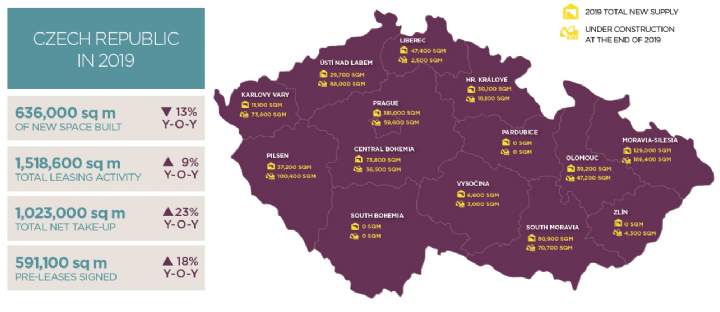
  • New industrial premises delivered to the Czech market during all four quarters of 2019 totalled 636,000 sq m (12% less than in 2018).
  • By the end of 2019, the total stock of modern rentable industrial premises in the Czech Republic increased to 8.46 million sq m. Of that, 3.12 million sq m was situated in Prague.
  • Nationwide vacancy rate declined slightly in the final quarter of the year to 3.7%, while in Prague the share of unoccupied space rose marginally to 3.1%.
  • Construction pipeline grew to 690,500 sq m by the end of 2019; almost half of all that space was already pre-leased.
  • Total leasing activity in 2019 amounted to 1,518,600 sq m (9% above the previous year). Annual net take-up reached a record high of 1,023,000 sq m and was mostly driven by manufacturing companies.
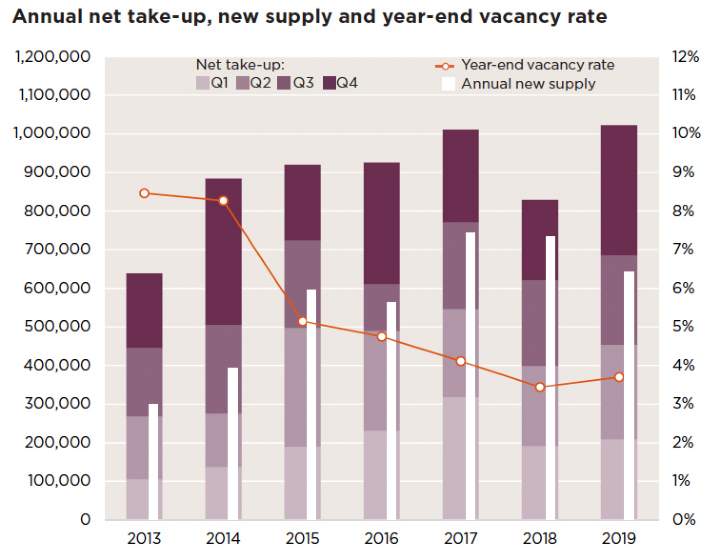
Image treatment

EXISTING STOCK AND NEW SUPPLY

In Q4 2019, industrial real estate developers constructed 164,000 sq m of modern logistic and production space intended for lease across the country. 18% of that space was completed on a speculative basis (i.e. without any secured tenant).

New supply of industrial space during the whole of 2019 reached a total leasable area of 636,000 sq m (down by 12% y-o-y), while the countrywide industrial stock was up to 8.47 million sq m by the end of 2019.

37% of total industrial stock was located in Prague and the vicinity of the city's outer ring road (3.12 million sq m). Pilsen was the second largest industrial submarket in the country with 1.23 million sq m of rented (or rentable) industrial stock. South Moravia (including Brno) made up the top three spots with 1.08 million sq m.

Image treatment

CONSTRUCTION PIPELINE

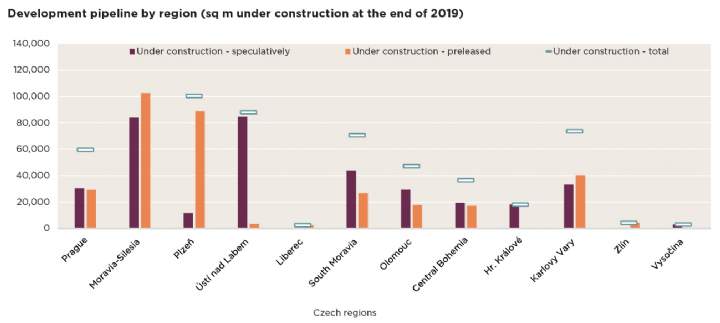
High occupancy levels and strong demand continued to drive new construction and the increasing share of speculative developments in 2019. Industrial premises totalling 690,500 sq m were under construction across the country at the end of 2019 and almost half (47%) of that development pipeline was already pre-committed. From 2014 when the vacancy rate hovered around 9%, the average share of speculative construction within the active development pipeline has increased from 11% to 50% recorded in 2019 (53% in Q4 2019).

At the end of 2019, the largest volume of new industrial space was under construction in the regional markets of Moravia-Silesia (186,400 sq m) and Pilsen (100,400 sq m). Although 88% of the space under construction in the Pilsen region was already pre-leased at the end of 2019, the level of speculative development in Moravia-Silesia was significantly higher, reaching 45%. Prague had industrial buildings with total leasable area of 59,600 sq m in various stages of construction, and 51% of that space was being developed speculatively.

VACANCY RATE

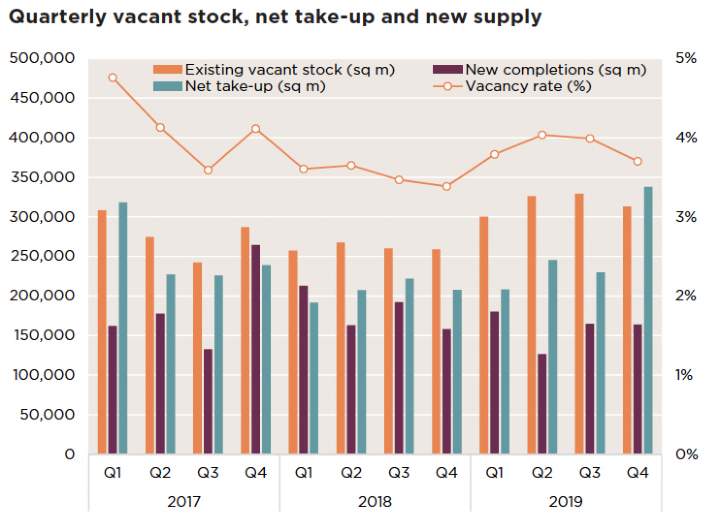
Due to the low volume of speculative completions (29,000 sq m) that were delivered to the Czech market in the final quarter of 2019, the nationwide vacancy rate fell by 29 basis points from Q3 and by the end of the year stood at 3.7%.

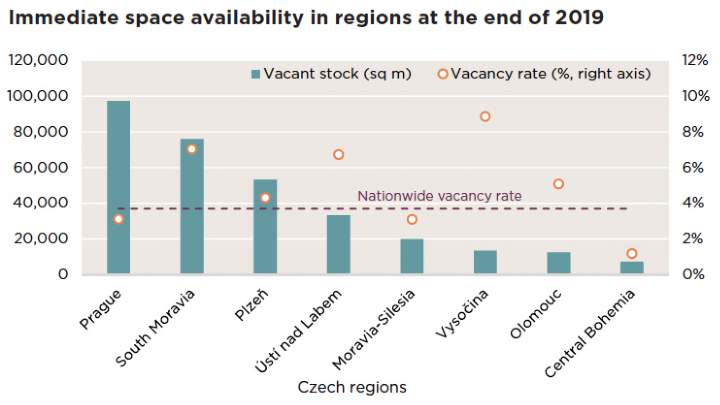
Nearly 313,200 sq m of modern industrial space was immediately available for lease across the country and almost one-third (97,400 sq m) of this unoccupied stock was located in Prague, where it translated into a local vacancy rate of 3.1%. The region of South Moravia reported the second highest volume of vacant industrial space (76,000 sq m), followed by the Pilsen region (53,200 sq m). 

Image treatment
Image treatment
Image treatment
Image treatment

OCCUPIER DEMAND

Total leasing activity reached its highest level in the last quarter at 403,200 sq m. This indicated a 6% increase on the previous quarter and a 20% improvement year-on-year.

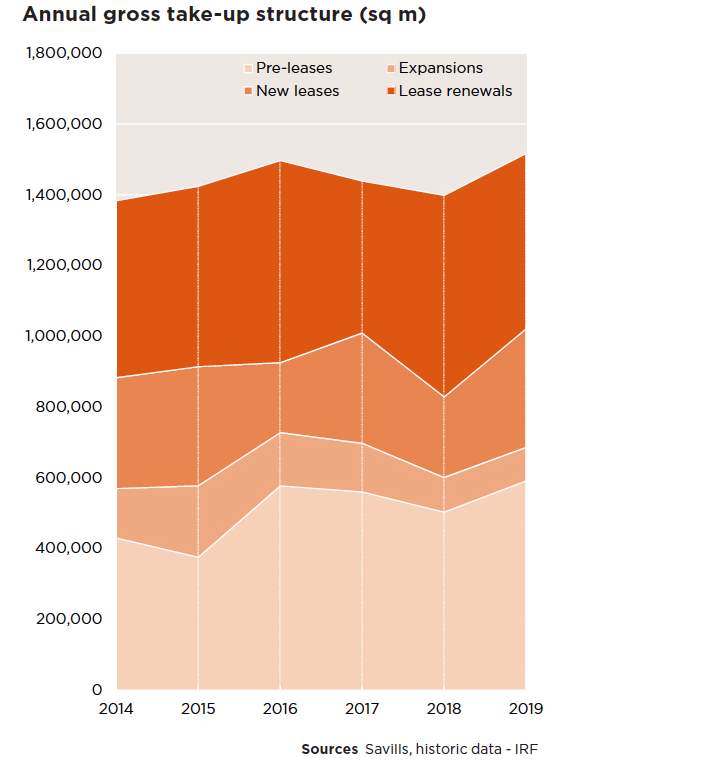
Annual gross take-up in 2019 came to 1,518,600 sq m, 9% above leasing activity recorded in the previous year. 35% of the annual gross take-up was generated in Prague-based industrial parks, 16% in the Moravia-Silesia region and 13% in the South Moravia region. In 2019, pre-leases accounted for 39% of annual gross take-up, which is in line with the previous three years, when lease commitments signed before construction completion accounted for between 35% and 40% of total leasing activit

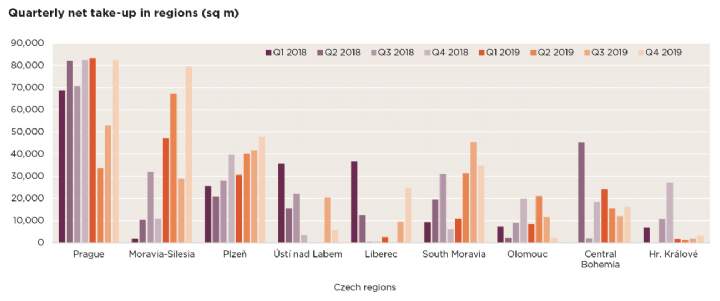
Net take-up registered in Q4 2019 totalled 337,800 sq m, which was the highest quarterly figure since Q4 2014, a 46% increase over Q3 2019 and 62% more than demand in the last quarter of 2018.

Overall annual net take-up in 2019 reached an all-time high of 1,023,000 sq m (23% increase y-o-y). Of the annual new demand volume, Prague attracted 25% of that, closely followed by the Moravia-Silesia region with record demand of 222,500 sq m (which equalled a net take-up share of 22%).

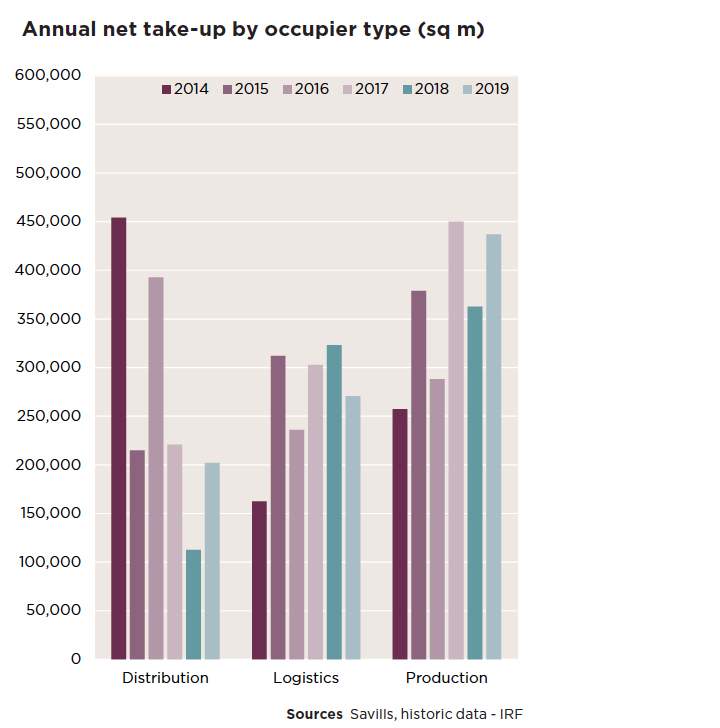
Manufacturing companies continued to drive new demand for modern industrial space in the Czech Republic. In 2019 production companies stood behind 43% of the total annual net take-up volume.

Image treatment

RENT LEVELS

Long-term high occupancy levels and increased construction costs (but in many cases also higher building standards) brought about further rent increase. At the end of 2019, headline rents generally started at around €4.00 per sq m a month but could reach as high as €4.90. Effective rents, which take into account any incentives and discounts provided by the landlord, stood at €3.00 – €4.50.

Headline rents for smaller units (around 1,000 sq m or less) in Prague oscillated between €5.50 and €6.50 per sq m a month.

Rents for office space within logistic or production halls remained stable at €8.50 – €9.50 per sq m a month.

Monthly fees for service charges generally ranged from €0.55 – €0.70 per sq m, but in smaller business units of around 500 sq m came to €0.90 – €1.00.

Image treatment